Farm & Harvest 3 min read
Reading the water, how sensors cut our harvest shutdowns by a third
The hardest problem in tropical oyster farming is not growing them. It is knowing which days not to harvest. Here is how we stopped guessing.
By Ocean Tide Ventures
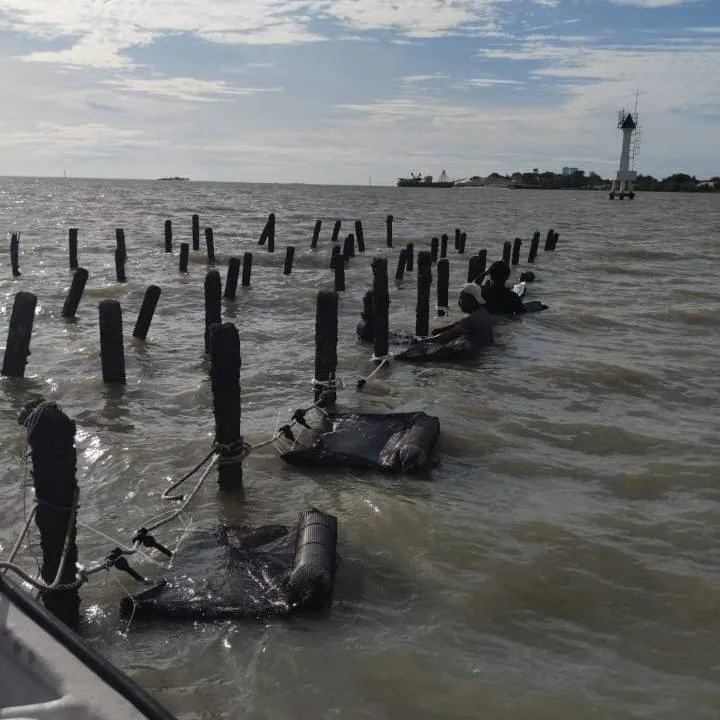
There is a version of oyster farming that exists in people’s heads: you put the shells in the water, you wait, you pull them out. If that were the job, this would be an easy business.
The actual job is deciding which days you can harvest and which days you cannot. Get that wrong in either direction and it costs you.
Two ways to be wrong
Harvest when you shouldn’t. A heavy downpour upstream drops salinity in the bay and flushes whatever is on the land into the water. Harvest into that and you are depurating against a much higher starting load, or shipping something you should not have.
Don’t harvest when you could have. This is the failure nobody talks about. Faced with uncertainty, the safe move is to stop. Stop often enough and you miss deliveries, disappoint buyers, and leave stock on the line past its best. For a farm whose crews are paid by the day, defensive shutdowns are expensive.
For years the industry has made this call the same way: look at the sky, look at the water, ask someone who has been doing it for thirty years. That intuition is real and it is genuinely good. It is also unevenly distributed, impossible to hand over, and it works on today rather than next Thursday.
What we measure
We run IoT sensors across our sites, logging four things continuously:
- Salinity, the fastest indicator that freshwater runoff has arrived.
- Water temperature, drives both growth rate and bacterial load.
- Tide state, determines how much exchange the bay is actually getting.
- Rainfall, the leading indicator for everything above.
None of that is exotic. What changes things is having it continuously, across every site, in one place, with history behind it.
From measuring to predicting
A single reading tells you about now, which is already too late, you find out conditions have gone bad after your crew is in the water.
The value is in the accumulated record. Once you have months of readings and can see how this bay responds to this pattern of rainfall at this tide state, you can start projecting forward. The system flags conditions moving out of range before they arrive.
That turns the harvest decision from a morning judgement call into a plan you can make days ahead, and just as importantly, into something a new site manager can act on without thirty years of local knowledge.
The number
Since we started running this properly, we have reduced harvest shutdowns by up to 30%.
It is worth being precise about what that number is and is not. We have not started harvesting in conditions we previously avoided, our thresholds have not moved. What has changed is that we no longer shut down defensively on days that turn out to be fine, and we are no longer surprised by the days that are not.
Fewer wasted crew days. Fewer missed deliveries. Same standard.
What’s still hard
We are not finished. The models are only as good as their history, and our Melaka site is new enough that we are still building its baseline. Sensors fail, usually in weather, usually at the least convenient moment. And no amount of data replaces someone experienced standing on the raft and saying something is off today.
The goal is not to remove that judgement. It is to give it better information, and to make it something we can hand on rather than something that walks out of the door when a good farm manager retires.
- technology
- harvest
- water quality