Ladang & Tuaian 3 min bacaan
Notes from the hatchery, why an oyster farm starts in a room full of flasks
Visitors expect boats. The first thing we show them is shelves of glowing green flasks, because that is where reliable oysters actually begin.
Oleh Ocean Tide Ventures
Cerita ini belum diterjemahkan. Anda sedang membaca versi Bahasa Inggeris.
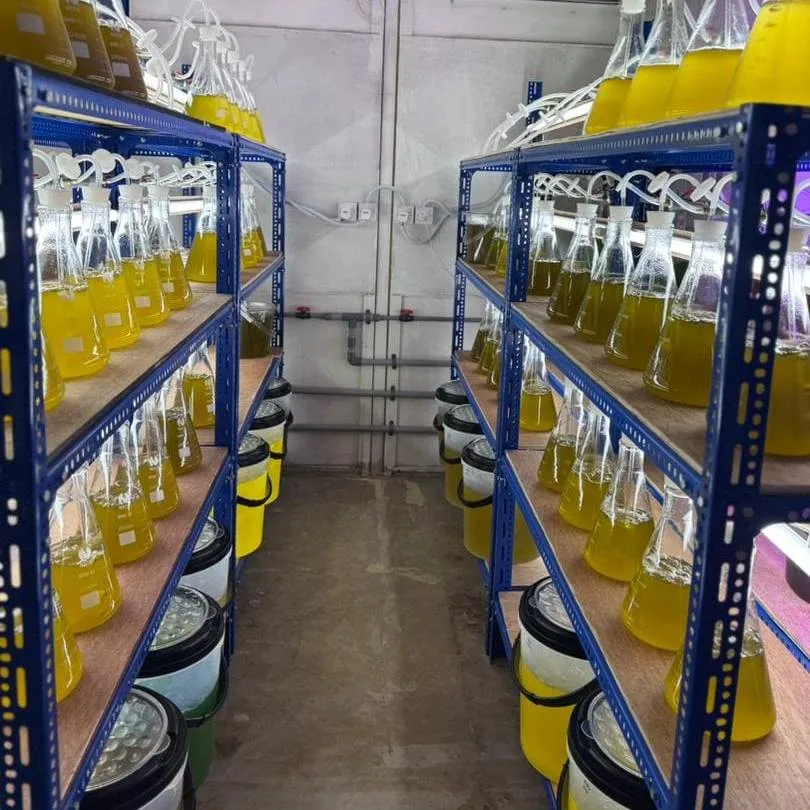
Everyone who visits the farm expects to start on a boat. We start them in a room that looks like a school science lab: rows of conical flasks on steel shelving, each one glowing a slightly different shade of gold and green, air lines bubbling away.
This is the algae room, and it is the actual beginning of the business.
Larvae have to eat
An oyster larva is microscopic and it is hungry. Before it settles and becomes recognisable as a shell, it spends its time in the water column eating single-celled algae, and it is fussy about which ones.
You cannot buy that off a shelf in the quantities a hatchery needs. So we culture our own: a handful of species maintained as pure starter cultures, stepped up through progressively larger vessels until there is enough volume to feed a tank of larvae.
It is more or less continuous. An algae culture is alive; it crashes if the light, temperature or nutrients drift, and it takes weeks to rebuild from a starter if you lose one. The unglamorous truth is that a good hatchery is mostly a well-run algae operation with an oyster problem attached.
Why we bother
We could buy spat. Plenty of farms do, and for a long time that was the only realistic option in Malaysia.
The trouble with buying seed is that you inherit everything about it. Somebody else’s genetics, somebody else’s disease history, somebody else’s delivery schedule. A shipment that arrives three weeks late does not cost you three weeks. It costs you a season, because the grow-out window has moved and you are now harvesting into the wrong conditions.
We went upstream for the same reason we do our own depuration: the promises we make at the end of the chain are only worth anything if we control the beginning of it.
Triploid and diploid
Working with Malaysia’s licensed hatcheries, we produce both.
Diploid oysters are the normal ones, two sets of chromosomes, they spawn seasonally, and during that window the meat goes thin and milky as the animal puts everything into reproduction.
Triploid oysters have three sets and are functionally sterile. They do not divert that energy, which means they stay in condition through the season and keep growing when diploids stall.
Triploids are well established in temperate oyster farming. In tropical water, at commercial scale, there is genuinely less known, which is why we are working on it with research institutions rather than claiming it is solved. It is the single biggest seasonal gap in this industry and we would like to close it.
We sell the seed too
Here is the part that surprises people commercially: we supply spat to other Malaysian growers, including ones who compete with us.
Reliable seed is the biggest constraint on oyster farming in this country. As long as it stays that way, the industry stays small, and a small industry means a fragile supply chain, thin infrastructure, and buyers who default to imports because they cannot count on local volume.
We would rather be one good farm among many than the only one. So the surplus goes out, spat, microalgae, seaweed and equipment, to anyone serious about farming properly.
That is not charity. An industry is a much better thing to be part of than a lonely success.
- hatchery
- microalgae
- spat